


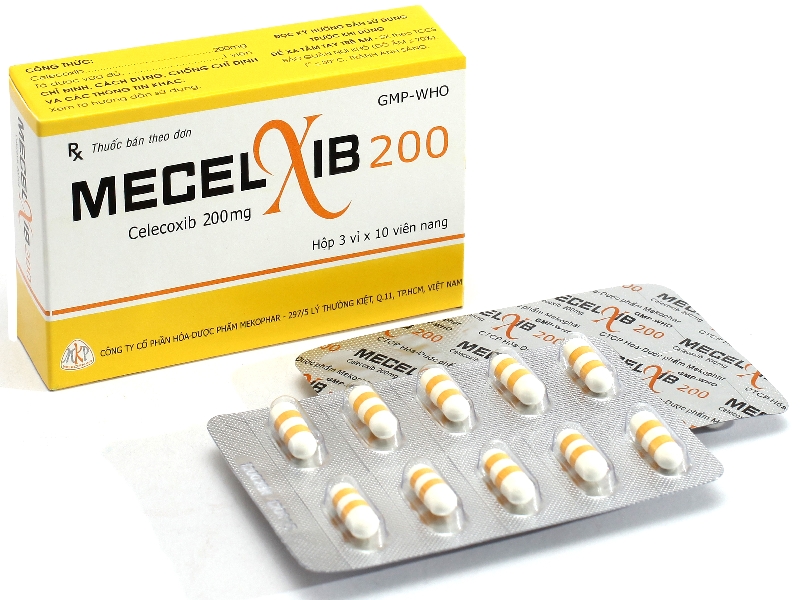
Mecelxib 200
Indications
– It is used in the treatment of osteoarthritis and rheumatoid arthritis.
– It is used for the relief and reduction of signs and symptoms of ankylosing spondylitis.
– It is also used for management of pain in post– operative, dental surgery, dysmenorrhea.
– Celecoxib is also used as an adjunctive treatment in familial edematous polyposis (for reduction of the number of adenomatous colorectal polyps).
Present
– Blister of 10 capsules. Box of 3 blisters.
Composition
Celecoxib…………………………………….…200mg
Excipients s.q. for.….…..……….……..….…1 capsule
(Colloidal silicon dioxide, Povidone, Lactose, Croscarmellose sodium, Magnesium stearate).
Pharmacology
– Celecoxib is nonsteroid anti– inflammation drug with anti– inflammatory, analgesic and antipyretic effects. The mechanism of action: it is selective
inhibitor of Cyclooxygenase– 2, thus causes inhibition of Prostaglandins that are key autacoids in inflammation, pain, and fever. At usual human
therapeutic doses, Celecoxib does not inhibit Cyclooxygenase– 1.
– Celecoxib use had shown to inhibit adenomas in an animal model of colorectal adenomatous polyps in a clinical trial.
Pharmacokinetics
– Celecoxib is well absorbed from GI tract with high fat meal. Peak plasma concentration of Celecoxib about 705ng/ml has been achieved within 2.8 hrs after a single dose of 200mg in fasting individuals. The elimination half– life of Celecoxib in such condition is about 11.2 hrs, protein binding is about 97%, the apparent volume of distribution of Celecoxib at steady state is about 400l. Celecoxib is metabolized in the liver mainly by the P450 isoenzyme CYP2C9. The metabolites are inactive as inhibitors of COX– 1 or COX– 2 enzymes. Celecoxib is eliminated mainly as metabolites in the feces and urine, less than 3% is recovered as unchanged drug. Following oral administration of a single 200mg dose of Celecoxib, approximate 57 and 27% of the dose was excreted in feces and urine, respectively. The principal metabolite in both urine and feces was the carboxylic acid metabolite.
Contra-Indications
– Hypersensitivity to Celecoxib and any ingredient of the medicine.
– Do not prescribe the drug to patients allergic to Sulfonamides.
– Do not prescribe the drug to patients with history of asthma, urticaria, allergic to Aspirin or other NSAIDs.
– For the treatment of peri– operative pain in the setting of CABG surgery.
Side effect
– Common: abdominal pain, diarrhea, dyspepsia, flatulence, nausea.
Pharyngitis, rhinitis, sinusitis, upper respiratory tract infections. Insomnia, dizziness, headache, erythema. Back pain, peripheral edema.
– Rarely: syncope, congestive heart failure, ventricular fibrillation, pulmonary embolism, cerebrovascular accident, peripheral gangrene, thrombophlebitis, vasculitis. Intestinal obstruction, intestinal perforation, GI bleeding, colitis with bleeding, esophageal perforation, pancreatitis.
Gallstone disease, hepatitis, jaundice, liver failure. Thrombocytopenia, agranulocytosis, aplastic anemia, pancytopenia, leukopenia. Reduced blood
glucose. Ataxia, suicidal ideation. Acute renal failure, interstitial nephritis.
Erythema multiforme, exfoliative dermatitis, Stevens– Johnson syndrome.
Infections, sudden death, anaphylactoid reactions, angioedema.
Inform your doctor about side– effects when using this medicine.
Precaution
– To minimize the potential risk, the lowest effective dose should be used for the shortest duration consistent with individual patients treatment goals.
– Celecoxib may cause an increased risk of serious cardiovascular thrombotic events, myocardial infarction, and stroke, which can be fatal.
Physicians and patients should remain alert for the development of such events, even in the absence of previous cardiovascular symptoms. Patients
should be informed about the signs and/or symptoms of serious cardiovascular toxicity and the steps to take if they occur.
– Caution should be exercised in patients with history of or with peptic ulcers, gastric bleeding and upper GI inflammation, and patients taking
concomitant Aspirin.
– Caution should be exercised in patients with liver impairment, kidney dysfunction and elderly patients.
– Celecoxib doses not inhibit platelet aggregation and cannot be a substitute for low– dose Aspirin in preventive therapy of cardiovascular diseases.
PREGNANCY AND LACTATION:
– Avoid using Celecoxib in the last trimester of the pregnancy because it may cause premature closure of ductus arteriosus.
– It is not known that Celecoxib may pass into breast milk, therefore, use only when clearly needed and discontinue breastfeeding if the drug is used.
Interaction
– Celecoxib may reduce the antihypertensive effects of ACE inhibitiors.
– Celecoxib increased prothrombin time (INR) in patients on use of Warfarin. Patients should be monitored closely for the effect of anticoagulants or dose adjustment should be made after initiation of Celecoxib.
– Fluconazole increases the plasma concentration of Celecoxib twice.
– Celecoxib can reduce the natriuretic effects of Furosemide and thiazides due to inhibition of renal prostaglandin synthesis.
– Concomitant administration of Celecoxib with Lithium salts may increase the serum concentrations of the latter.
OVERDOSAGE & MANAGEMENT:
– Symptoms of overdose: coma, drowsiness, nausea, vomiting, epigastric pain, gastrointestinal bleeding may occur, hypertension, respiratory failure,…
– Management: patients should be managed by symptomatic and supportive care. There are no specific antidotes. Emesis and/or activated charcoal and/or osmotic cathartic may be indicated in patients seen within 4 hrs of ingestion with symptoms or following a large overdose.
– Should overdosage occur, turn to the nearest healthcare facility for medical attention of the healthcare professionals.
Shelf life
36 months from the manufacturing date.
Storage
Store in a dry place (RH ≤ 70%), not exceeding 30oC. Protect from light.
Dosage
– As prescribed by the physicians.
– Osteoarthritis, ankylosing spondylitis: 200mg daily, single dose.
– Rheumatoid arthritis: 100 – 200mg, two times daily.
– Relief pain in post– operative, dental surgery, dysmenorrhea: recommended dosage: 400mg, initially followed by an additional dose of 200mg if
necessary, on the 1st day. For continued relief, 200mg may be administered twice daily as needed.
– Celecoxib is also used as an adjunctive treatment in familial adematous polyposis: 400mg, two times daily (with meal to increase absorption).


Reviews
There are no reviews yet.